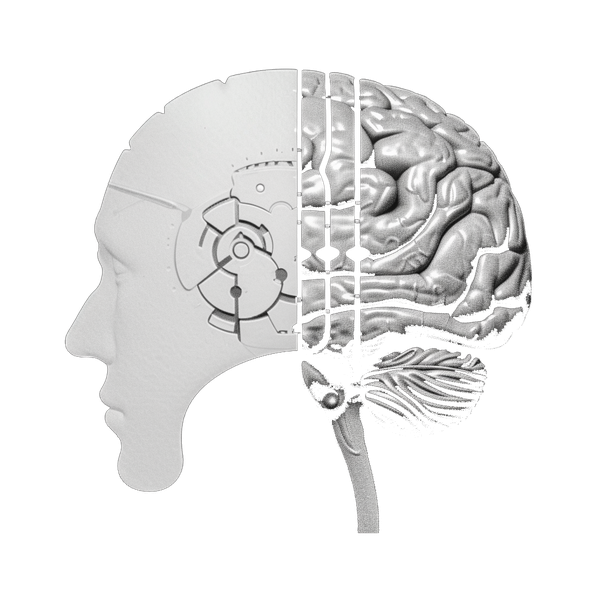

For the second time in two years, the businessman and billionaire Elon Musk sat down with podcaster Joe Rogan to talk about the future of AI and its role in the symbiosis of human and machine. In their conversation, Musk revealed that Neuralink, the company he co-founded to achieve an effective interaction between brain and machine, is very close to starting trials with real people.
“We’re not testing on people yet, but it won’t be long,” Musk told Rogan. “We’ll be able to implant a neural link in a person in less than a year, I think.” He made this statement recently, so perhaps 2020 will be the year a truly functional and powerful brain-machine interface is launched. “Even in a benign scenario, AI is leaving us behind,” Musk said. “So how are we going to avoid being left out of the new Era of Artificial Intelligence? If you can’t beat it, merge with it.”
“We’re already cyborgs in a way,” Musk told Rogan. “You have your smartphone, your laptop… If you lose your smartphone, you can even suffer phantom limb syndrome.” Our dependence on Technology keeps growing, and above all in the new world to come, we will be absolutely dependent on the Ultimate Technology, Artificial Intelligence.
The World’s First Cyborgs: Humanity’s Next Evolutionary Phase Is Here
In a small, dark experiment room, Bill, a quadriplegic man in a wheelchair, stares at a simulated arm on a computer screen. Two tentacle-like cables stick out of his skull and plug into a nearby computer, which sends messages to the electrodes implanted in his arm and hand. If the experiment succeeds, Bill will move his limbs again. This opening scene of Futurism’s newly released documentary “I AM HUMAN” sets the stage for the revelations to come. With this technology, Bill may one day be able to move other things with his brain signals. We are talking about telekinesis; we are talking about Human-Machine interaction through Thought.
Although Bill does not look like the Cyborgs we are used to seeing, the image is just as compelling, and it represents a much larger real-world phenomenon. In fact, Bill is one of the many pioneers of the first wave that ushered in a biotechnological revolution. Currently, more than 200,000 people in the world have Digital Technology bio-implanted in their brains.
Technologists, scientists, investors, philosophers and ethicists have a great debate ahead of them. While “I AM HUMAN” acknowledges the concerns about “playing God”, it challenges the fear-driven narratives surrounding the evolution of the Machine-Human with an unshakeable optimism, based on the real-life stories of people who can benefit directly from these advances.
Google’s Brain Bioimplants Could Make Learning Obsolete in 20 Years.
Possibly within 20 years we could have brain implants that let us learn everything. We would not need to memorize anything, nor would there be any need to search anything on Google, since the answers would simply appear in our mind. Without making a sound or typing anything, with thought alone, we will be able to ask ourselves something like ‘When did the Vietnam War end?’ or ‘Tell me the life of Aristotle slowly’ and instantly we will hear the answer from the modular Artificial Intelligence bioimplant and be able to repeat it in our own voice.
This unprecedented access to all the knowledge stored on the Internet, together with HyperConnectivity and 5G speeds, amounts to a new real-time relationship with what we know and can immediately know. And not only historical knowledge but any information stored on the Net: memorization and learning will change forever. But this will only happen if we hybridize, so it will almost become an obligation in order to live in the New Society that awaits us.
Faced with these scenarios that are already very close, the question is not whether we will be Bioimplanted with Neuralink or any other corporation such as Google Brain Implants, or whether we will become Augmented Humans or PostHuman Cyborgs, hybridized with an Artificial Intelligence system adapted to our brain.
The real question is whether we will have a safeguard to use this BioTechnology only when it is necessary, and when it is not, to recover our true human nature. This fundamental right is what we call the “Right to Disconnect”, and it should allow us to switch off all existing Technology within a 2-kilometre radius at the very least, including whatever is in our own body.
Originally published in Spanish on IANética (2020). English version prepared for TecnoHumanismo.
Related articles
The Right to Technology
The information society keeps transforming our world. To leave no one excluded, we must guarantee the fundamental right to Technology.
Read article →4 min
The Right to the Integrity of Being in the Age of Neurotechnology and Cyborgization
Neurotechnology and cyborgization promise advances in medicine and communication, but raise ethical challenges for autonomy, privacy and human integrity.
Read article →6 min
The Right to the Supremacy of the Human Being over the Machine
The Machine must always serve the Human Being. Defending our right to supremacy must be one of the main goals of the 21st century.
Read article →4 min