
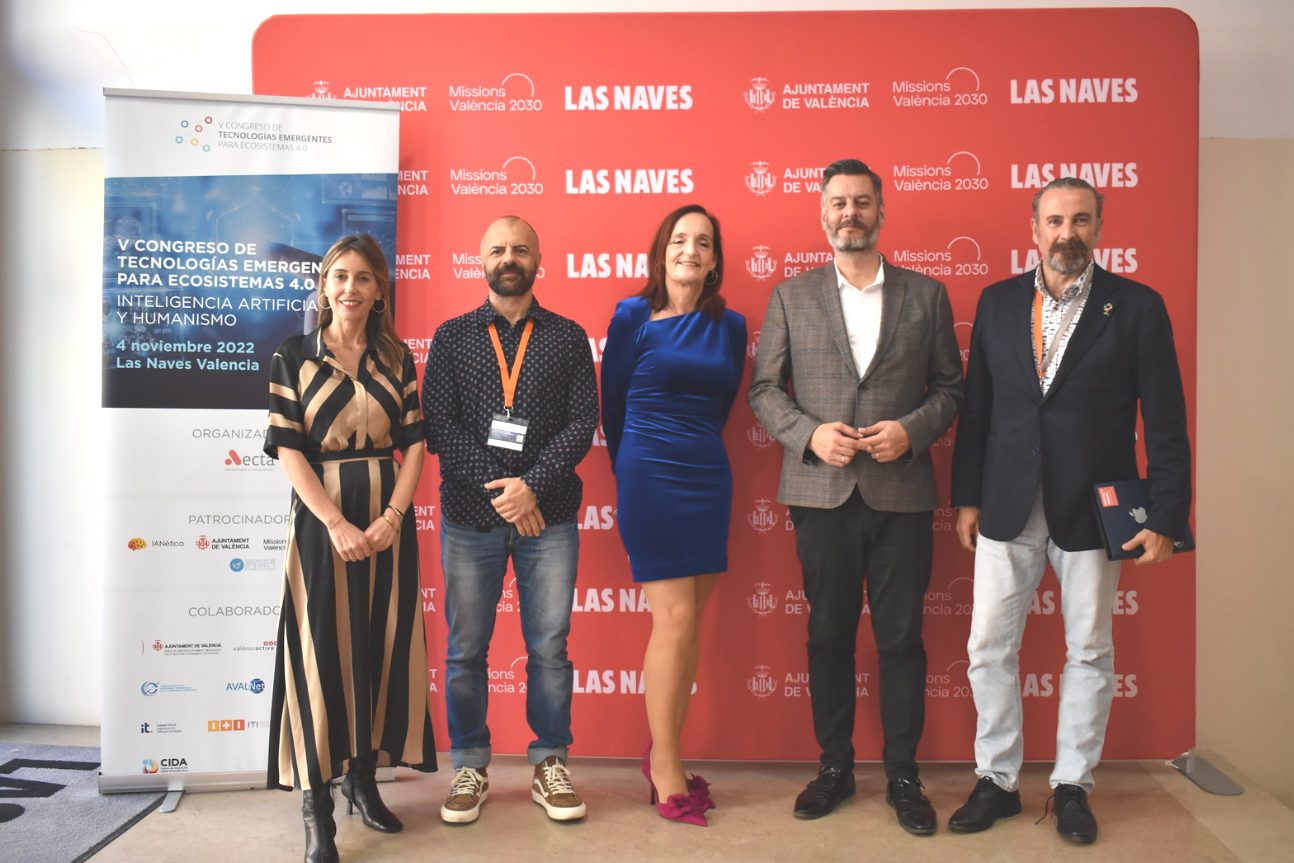
On 4 November, the V CONGRESO DE TECNOLOGÍAS EMERGENTES PARA ECOSISTEMAS 4.0 (5th Congress on Emerging Technologies for 4.0 Ecosystems) was held in Valencia, at the Las Naves building, the main headquarters of the IANética project. Its main theme was Artificial Intelligence and Humanism, and it was organised by AECTA. Pedro Mujica gave the opening talk, titled: “Technohumanism and Human Empowerment: Foundations of the Fifth Industrial Revolution”.
This article gathers some of the questions put to Pedro Mujica about his talk “Technohumanism and Human Empowerment: Foundations of the 5th Industrial Revolution”, in which the Humanist Technologist explained how TecnoHumanismo aims to put technology at the service of people. And, in this regard, the necessary development of an ethics that allows technological advances to benefit human beings and society.
What are the three or four key ideas you want the attendees of your talk to take away?
- That there is no need to fear automation
- Work is under way at every institutional level to make sure that technology is at the service of people
- What Human Empowerment means, where mechanical, dangerous and routine tasks will be delegated to Artificial Intelligence. In this way, humans will have more time to carry out successfully those tasks that only reason can perform.
- What Technohumanism means, as a union between Thought and Technology, arising from applying the ideas and theses of the Human Disciplines to the Disruptive Emerging Technologies of the Fourth and Fifth Industrial Revolution.
In your talk you use the term “Technohumanism”. What exactly does this term mean?
The Fourth and Fifth Industrial Revolutions are the Genesis of TecnoHumanismo, and they mean not only a revolution of industry but also of the Human Being as we knew it. More than ever we must foster the development of a new Ethics and the recovery of Anthropocentric Thought brought into the Technological context.
And so that this change leads us toward the best of all possible futures, this Technohumanist Movement was born, uniting Thought, Philosophy and Ethics with Science and Technology. It applies the ideas and theses of the Human Disciplines to the Disruptive Emerging Technologies of the Fourth and Fifth Industrial Revolution, with a Techno-Anthropocentric approach in which Technology always remains at the service of the Human Being. Its three fundamental principles are:
- HUMANISM as a vital attitude that conceives human values in an integrated way, in the context of a Second Renaissance, where the anthropocentric vision puts technology at the service of the human being.
- EDUCATION, understood as a basic need for achieving adaptation to, and knowledge of, the new digital society, fostering continuous self-learning, creativity and innovation.
- SOLIDARITY, in order to face the existential challenges confronting us together and as individuals, we must unite as a single species and overcome all our conflicts through the awareness that this is the only possible path.
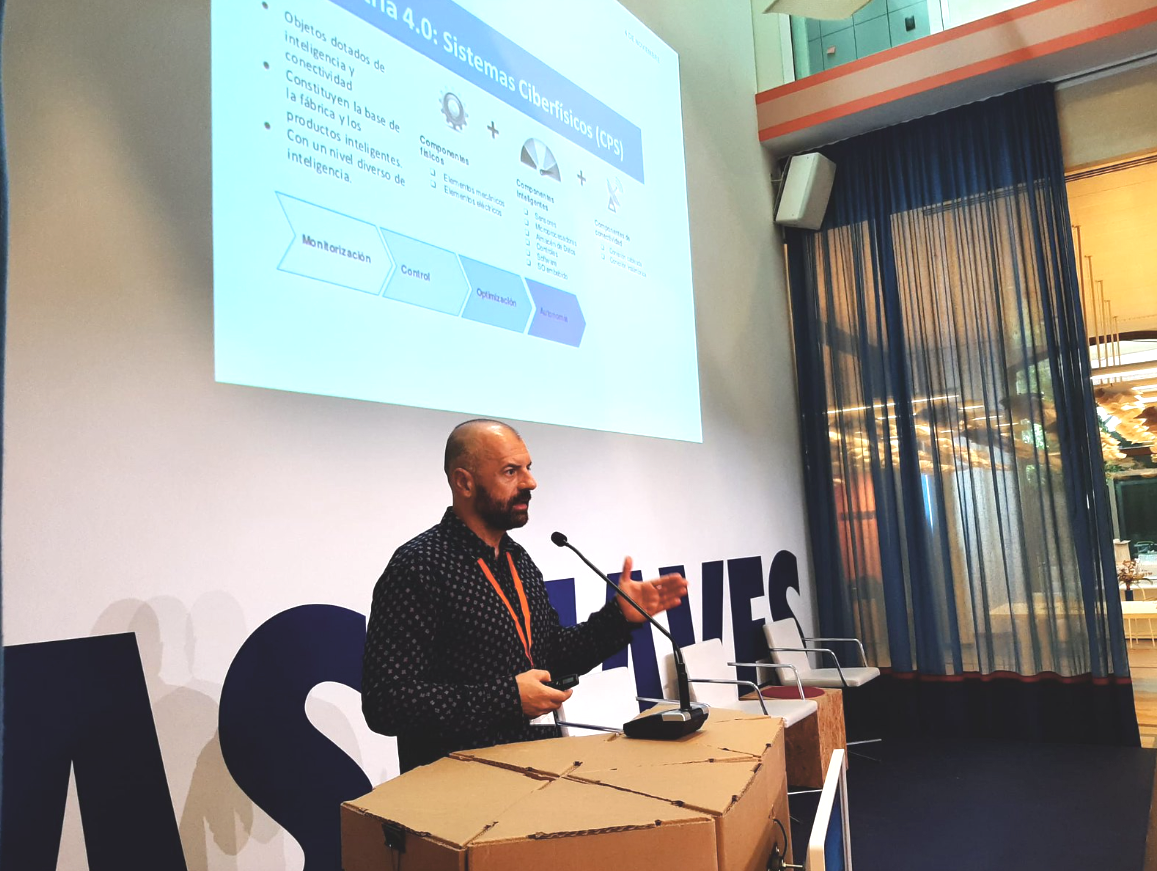
In general, do companies take human empowerment into account when they transform digitally?
We are in the midst of an enormous change, but the educational work within the business fabric is only just beginning. It is the task of digital transformation experts to adopt this approach and show the way so that human empowerment, as one of the fundamental characteristics of the Fifth Industrial Revolution, is not only taken into account but becomes the main driver of that transformation. It is the way.
What do companies that take human empowerment into account in their digital transformation gain?
Advances in industry are unstoppable. In fact, technological revolutions follow one another in ever shorter periods of time. Although organisations will adapt gradually to the fifth industrial revolution, by the end of the process the foundations of the sixth will already have been laid. These cycles feed back into each other; we are going to live in a world of constant change. Only change remains. Industry 5.0 gives the leading role back to the human being.
This process seeks to improve productivity in industry while, at the same time, aiming to reduce the endemic coldness of these environments. In this way, human beings regain prominence over machines, which are relegated to being our eternal assistants. It is the supremacy of the Human Being over the Machine, a fundamental issue to which every effort must be devoted.
Are we already talking about a 5th industrial revolution? In your view, what are its most notable characteristics?
Personalised manufacturing.
Deployment of cobots.
Human empowerment.
Speed and quality.
Environmental respect and Sustainability.

And Artificial Intelligence, another of the keys of this congress: how is it evolving and how will it evolve in the coming years?
AI is evolving at a speed that is hard for the Human Being to grasp, and it will do so even faster in the coming years. We cannot foresee what consequences the enormous development taking place in this field will have. We are facing a Cognitive Revolution, in which many of the skills that until now were the preserve of the Human Being become easily achievable with Artificial Intelligence systems and processes. Obviously we must say yes to technological progress, since well-directed AI brings enormous benefits, but with a great deal of reflection and above all with a braking mechanism and safeguard against scenarios that may not be easily reversible.
Today we are very close to entering the era of Artificial General Intelligence, and this is what is truly dangerous. I am referring to systems such as LaMDA, which was said to have become self-aware, although Google denied it, or huge models such as GATO, which can already perform more than 700 different tasks and surprised its engineers by teaching itself new tasks; it is more like our brain. Although some experts say we are far off, others assure us that the rise of AGI is imminent. The danger is therefore real, and the time is now.
Some scenarios where governments have to be very demanding are:
. Companies will have to self-regulate their Artificial General Intelligence technologies.
. Artificial General Intelligence could start a global arms race.
. Artificial General Intelligence might not be aligned with our goals.
. We do not know how Artificial General Intelligence could be controlled.
. Artificial General Intelligence could greatly increase inequality.
What would you say to those companies that have not yet taken the step of transforming digitally, because of resources, time…?
This is a global ill. Anyone who does not throw themselves fully into Digital Transformation and make it one of their main priorities runs the risk of being left behind and disappearing very quickly. It is not a matter of resources or time; it is an imperative and they have to undertake the process now. But it is hard because they do not see it, they do not understand the enormous changes taking place in this era. In the next decade there will be only two kinds of companies: technology companies with AI systems, and dead ones.
Originally published in Spanish on IANética (2022). English version prepared for TecnoHumanismo.
Related articles
Technohumanism and Human Empowerment: Foundations of the Fifth Industrial Revolution
At the AECTA Emerging Technologies Congress in Las Naves, Pedro Mujica opened with a talk on technohumanism and the Fifth Industrial Revolution.
Read article →5 min
Searching for Vocations. Universidad Europea and ATRESMEDIA
A 7-minute report for Universidad Europea and ATRESMEDIA in which Pedro Mujica discusses the future of professions and computational thinking.
Read article →3 min
Technology and Individualism: The Right to Remain Human
Rising depression, loneliness and child and youth suicide are multifactorial, but technology is one of their main drivers in recent years.
Read article →4 min