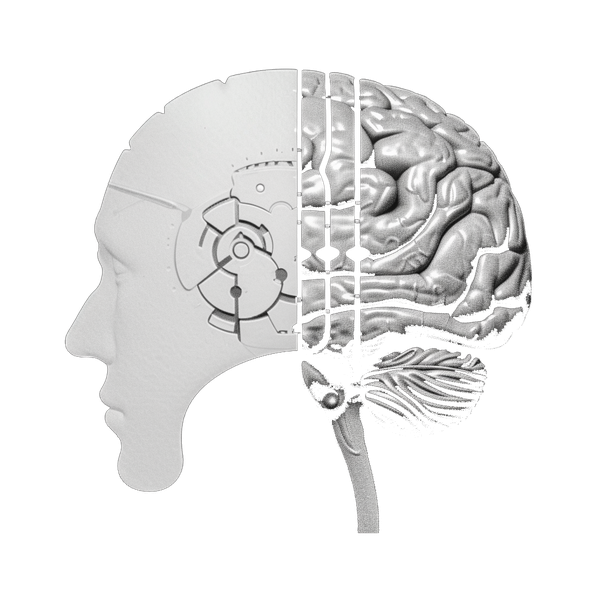

When we talk about Education 4.0 we are talking about a revolution in the traditional educational models that are still in force. It is not an idea tied to the most advanced educational centres and their technological capabilities; it is a change that has become essential and urgent.
The emerging technologies of the Fourth Industrial Revolution such as Extended Reality, Artificial Intelligence, Big Data, Blockchain, Robotics and Cobotics or the Internet of Things (IoT) are already having an unprecedented impact on industry, the economy, communications, the way of doing business, marketing, systems and politics, among many other fields. Within this context, Education 4.0 is quickly becoming a tangible option for the accelerated world in which we live, where these technologies are constantly evolving, teaching students how they must learn to cope.
Today’s students, regardless of their age, income level or location, must be prepared for the new dynamics we are experiencing. This means that they must learn a series of skills and abilities that allow them to be competitive and to adapt to the constant changes that occur at ever greater speed. Some of these competencies are the ability to solve complex problems, teamwork, communication, adaptability, emotional intelligence, critical thinking and, above all, computational thinking.
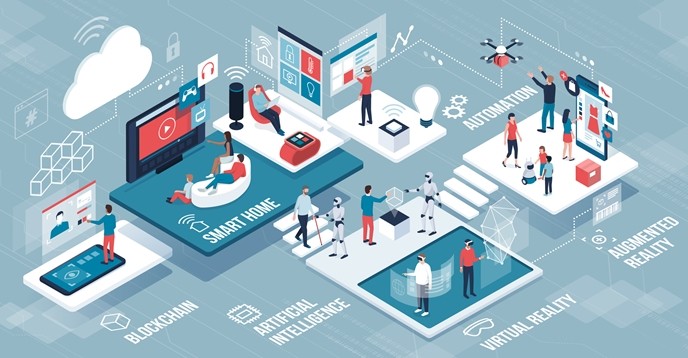
One of the key objectives is to understand how learning through Extended Reality and Artificial Intelligence can help develop thinking skills, which allow students to understand in a more divergent and critical way, and to make efficient use of the information available in digital environments to produce knowledge and apply it positively and productively in their personal lives and in society.
We must change our outlook and accept that the new Education 4.0 is not centred on content, but on making competent students, who know how to do and, above all, know how to be. Extended Reality and Artificial Intelligence are above all experiential; they change classroom dynamics and allow a greater focus on cooperative and competency-based aspects, where content becomes student-centred, making it possible to develop fully personalised learning adapted to each student.
Numerous studies in this area suggest that 65% of primary school students, for example, will hold jobs that do not yet exist and do not even have a name. The working environment they enter may be unimaginable today, possibly a mix of virtuality and physical reality; the only thing that is clear is that it will be closely tied to emerging digital technologies. The fundamental aim of Education 4.0 will be to prepare its students for an advanced digital technological future and, on the other hand, to support educators so that they become true facilitators of learning in this new educational model.
Flipped learning
One of the most successful formulas of Education 4.0 is the combination of digital technology and face-to-face learning. Platforms such as Google Classroom and MS Teams, or Clevertouch apps such as Day Dream Education and Revision Buddies have enabled some educators to adopt a flipped-learning style in the classroom, where digital technology helps put this new style of education into practice. Online platforms allow students to absorb a large amount of knowledge at their own pace, and then apply what they have learned across a variety of topics that are shared openly and collaboratively. The result is access to broad learning connected in an intuitive way, in the manner of mética (knowledge based on intuition and experience), instead of limited learning on scattered topics that are opaquely structured.
Project-based learning
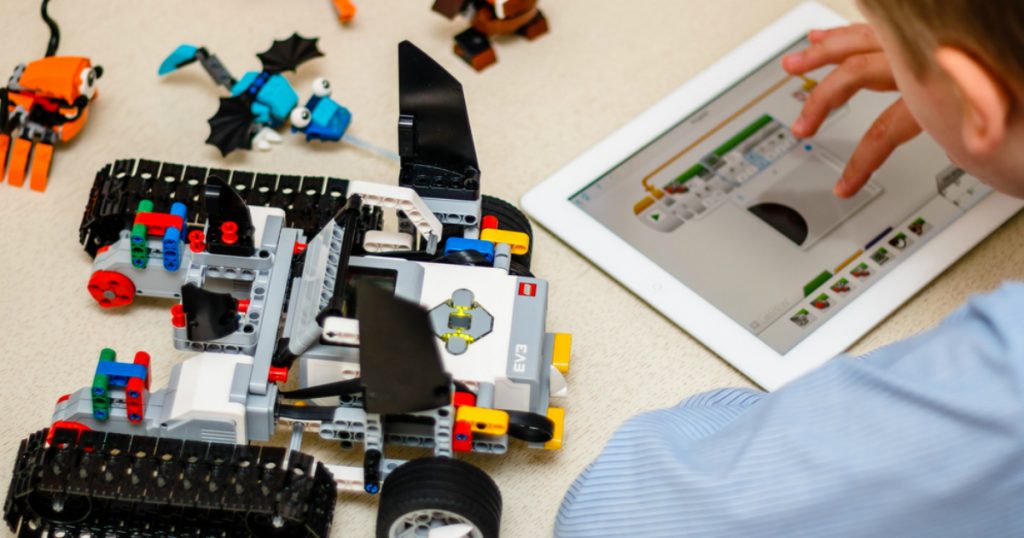
Generation Z will use digital tools as an essential part of their daily learning. Education 4.0 tools can make it easier for schools to distribute the material of educational programmes. Online platforms are much more than a substation of written tools, since they allow tasks to be redesigned in real time, which fosters creativity and shifts the focus.
All resources are easily shared among students, multiplying and spreading in the cloud. All this leads to orienting content around the students’ work, which is organised in cloud-based projects, making it possible to share it, along with its resources, with any other educational centre around the world. The impact is tremendously positive and makes it possible to hybridise the STEM approach with a new area of knowledge, Art, creating a new paradigm, STEAM learning, which recognises the fundamental role that arts-based subjects play in a comprehensive understanding of the curriculum.
Personalised adaptive learning
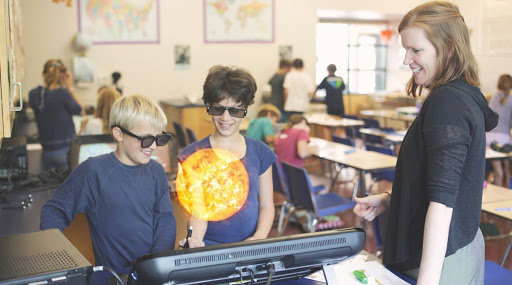
The Internet of Everything, 5G technology and 4K and 8K resolutions will make it possible for truly personalised learning to become a reality and happen in real time. For example, classrooms with Clevertouch boards are taking advantage of mirroring technology, showing several mobile devices at once on their screen, which makes it possible for the more able students to speed up their learning, while the rest follow a more standard pace until they master the required knowledge before moving on to the next stage. Besides sharing content in real time, high hyperconnectivity will allow instant access to enormous amounts of knowledge.
An imminent future
Talking about the future of the classroom when digital technology comes into play is simply conjecture, since it changes and evolves at an accelerated, exponential pace, so it is very hard to predict accurately what education will look like in 2025 or 2030.
But what is clear is that educational digital technology will change the way we see traditional learning spaces. The new spaces are not only taking shape under a new topology, but their very nature is shifting from purely face-to-face and physical to a new mixed model in which the real and the virtual coexist, and whose two main technologies will undoubtedly be Extended Reality and Artificial Intelligence, enabling today’s students to become the leaders of the technological landscape that develops in this decade.
Originally published in Spanish on IANética (2020). English version prepared for TecnoHumanismo.
Related articles
OPEN IANética TRAINING: Artificial Intelligence and Extended Reality in Education 4.0
Open training to promote ethics in artificial intelligence and the Internet of Everything. IANética project of Las Naves.
Read article →4 min

Education in 2030 and the Key Aspects of Learning 4.0
Education 4.0 must develop alongside the Fourth Industrial Revolution and shares its 4.0 Technologies. These are the key aspects of Learning 4.0 for 2030.
Read article →6 min
The Only Thing We Were Missing: Toward a Psychopathic Technology?
Could a machine be cruel, perverse, evil? Yes, as Norman shows, the world's first artificial intelligence trained to think like a psychopath.
Read article →3 min